A fourth-generation space station.

Orbit becomes a place people can stay as long as they need, and live well the whole time — running experiments, building products, or just watching Earth go by.

The station

Room to stay, built for the launchers that exist now

Seven modules and about 2,200 cubic meters of pressurized volume — more than twice the International Space Station. Each module is roughly 350 cubic meters, the size of three ISS-era modules in one, and sized to the 150-tonne launchers flying today.

7modules
~2,200 m³pressurized volume, more than twice the ISS
~350 m³per module — three ISS-era modules in one

It rotates

The ring turns slowly enough to be comfortable and fast enough to matter. The hub stays in microgravity for research and manufacturing. The rim provides partial gravity — about what you would feel on the Moon — where people live. You choose the gravity by choosing where you are.

Built heavy on purpose

Launch capacity has stepped up, so the design stopped optimizing for mass. Thicker walls shield the crew with their own material. Simpler structures are quicker to build, easier to maintain, and more forgiving. Room to work is the product.

Why

What retires with the ISS is the ability to stay

The International Space Station retires around 2030. Capsules will keep flying, and they are enough for missions of a few days. What disappears with the station is something different: the ability to stay in orbit for weeks and months, with room to work and the life support to do it well.

Two markets depend on that. Private astronauts have been short of seats for most of two decades. Research and manufacturing programs aboard the ISS have run at the station's capacity for three years. Neither is short of demand. Both lose their platform at the end of the decade.

Strident is built for the part that disappears.

What we offer

We rent the conditions. Customers own the applications.

Microgravity, deep vacuum, life support and crew time — offered as capacity to organizations that bring their own work.

Government and sovereign programs

Multi-year capacity for national astronaut programs and agency research, on a platform designed to the standards those programs already use.

Research and manufacturing

Rack space, crew time and the environment itself, for pharmaceutical crystallization, bioprinting, materials and semiconductor work — programs that today have nowhere to go but the ISS.

Private astronauts

Accommodation for extended stays, from weeks to months, with transportation arranged separately through the crew launch providers.

Where we are

Founder-led, and moving

Team

One founder, one advisor
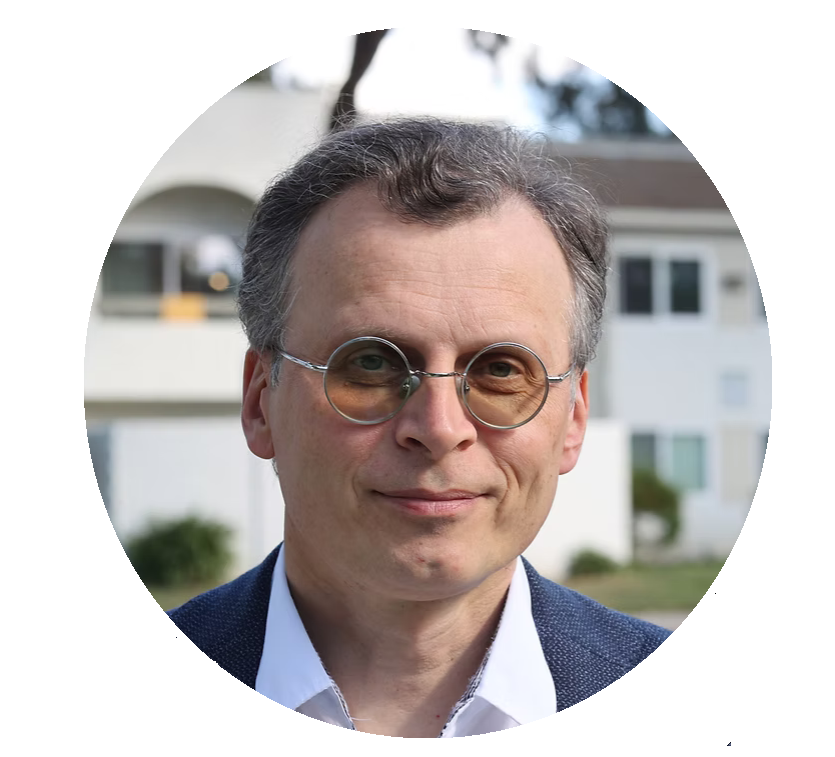
Alexander Mikhaylov
Founder & CEO

Alexander Mikhaylov

M.S. Physics, Moscow Institute of Physics and Technology. Twenty years building large distributed mission-critical systems at Microsoft, Apple and Automation Anywhere. Co-founder of IonKey.

Pavel Shpin
Advisor

Pavel Shpin

Serial founder with a successful exit. Electrical engineering and software; has held both CTO and CEO roles from founding through to acquisition.

Notes

On rockets, stations, and what comes next

Short pieces written since July 2025 — on how the first stations were built, what the new rockets change, and what the next station should be.

Read the notes →

Contact

Talk to us

Researchers and operators looking for capacity, agencies, press, and anyone who wants to talk about the station.

alex.mikhaylov@stridentspace.com